Map Quiz
what is the new area that we are supposed to study for tomorrow's quiz? is it south asia or southeast asia?
posted by Maria B. @ 6:46 PM
2 comments

what is the new area that we are supposed to study for tomorrow's quiz? is it south asia or southeast asia?
posted by Maria B. @ 6:46 PM
2 comments
The first question will involve the core-periphery model. You will need to identify example countries at both the core and the peripheral levels. You will need to identify the job sectors they fulfill and explain what those job sectors are.
posted by mrlewishistoricalsociety @ 3:13 PM
0 comments
Mr. Lewis mentioned the essay test being on tuesday is that correct or is it still monday
posted by Anonymous @ 6:04 PM
1 comments
http://www.cio.com/blog_view.html?CID=28994
posted by Mark C. @ 2:42 PM
0 comments
i thought i could help out some of you if you are having problems find info on the homework assignment due monday. I also realized that the powerpoint was not enough to do this assignment. so i leave you with 3 tips:
posted by Belfor @ 10:46 AM
1 comments
can anyone tell me if Mr. Lewis posted the power point slides?... if so where can I find them?
posted by Anonymous @ 10:49 PM
0 comments
Can you help me out / give answers to the following questions for me?
10 Some regions produce more cheese than milk because
a they are outside major milksheds
b of a cultural preference for cheese
c they are specialized
d the output is not sold directly to consumers
e both a and c
15 Unlike other forms of commercial agriculture plantations are
a part of agribusiness
b owned by people in the less developed countries
c found primarily in less developed countries
d all of the above
e both b and c
36. Agriculture that creates self-sufficiency with low product per acre and low population density is known as
1. extensive commercial agriculture
2. extensive subsistence agriculture
3. organic farming
4. intensive commercial agriculture
5. intensive subsistence agriculture
42. All of the following has limited the success of the green revolution except
1. the displacement of subsistence farmers
2. belated research efforts directed to traditional african crops
3. the difficulty of scientifically engineering high-yield rice strains
4. a decline in the genetic diversity of crop varieties
5. the destruction of large tracts of land by poor irrigation practices
48. the effects of biotechnology
1. are positive because they allow for much greater agricultural yields
2. are negative because the expense limits availability to all farmers across the globe
3. are unknown because very little research has been conducted on them
4. all of the above
5. none of the above
t
tjt
posted by Damian @ 8:51 PM
1 comments
1 What are the three main crops of large farms in America
posted by mrlewishistoricalsociety @ 9:58 AM
0 comments
1 The most important distinction for dividing the world into agricultural regions is
A whether the product is consumed on or off the farm
B whether crops are grown or animals are raised
C the location of the first agriculture
D the population density of crop-producing region
E the agricultural density of the crop-producing region
2 The cultivation of plants by cutting stems and dividing roots is
a sawah
b seed agriculture
c subsistence agriculture
d vegetative planting
e dry planting
3 Unique agricultural practices arrive in particular regions because of
a characteristics of the physical environment
b limited knowledge of alternatives
c distinctive cultural traits
d all of the above
e both a and b
4 Which is not a form of subsistence agriculture
a Mediterranean
b shifting cultivation
c pastoral nomadism
d all of the above are forms
e none of the following are forms
5 Which is not a characteristic of shifting cultivation
a land is cleared by slashing the vegetation
b debris is burned to provide the soil with nutrients
c a new site is designated every few years
d animals and crops have a symbiotic relationship
e all of the above
6 Shifting cultivation is found primarily in which climate region
a humid low-latitude
b dry
c warm mid-latitude
d cold mid-latitude
e Mediterranean
7 According to von Thunen's model, a commercial farmer is concerned with which costs
a price of land
b cost of transporting
c value of land per hectare
d all of the above considered
e none of the above
8 Von Thunen's model can be best be used to explain the location of which of the following types of agriculture
a dairying in the northeast U.S.
b ranching in the dry lands of North Africa
c shifting cultivation in the tropics of South America
d intensive subsistence in south China
e pastoral nomadism in southwest Asia
9 Other than corn, the most important crop in the U.S. Mixed crop and livestock region is
a wheat b soybean c grain d fruits and vegetables e nuts
10 Some regions produce more cheese than milk because
a they are outside major milksheds
b of a cultural preference for cheese
c they are specialized
d the output is not sold directly to consumers
e both a and c
11 Ranching has declined in the southwestern U.S. Primarily because
a crops yield more income per area
b the predominant breed of cattle has changed
c long-distance cattle drives are no longer practical
d the region lacks adequate water supplies
e American eat less beef
12 The different areas of the world where Mediterranean agriculture predominates share similar
a climate
b cultural beliefs
c levels of development
d social customs
e languages
13 Farmers in more developed and less developed countries share which of the following problems
a access to fertilizers
b inadequate income
c lack of equipment
d surplus production
e lack of labor
14 Less developed countries generate funds to promote development through
a bartering with urban residents
b encouraging traditional subsistence agriculture
c feeding the rapidly growing population
d selling export crops
e incurring debt
15 Unlike other forms of commercial agriculture plantations are
a part of agribusiness
b owned by people in the less developed countries
c found primarily in less developed countries
d all of the above
e both b and c
16 All of the following differentiate subsistence farming from commercial farming except
A purpose of farming
B percentage of farmers in the labor force
C size of the yield
D use of machinery
E all of the above
17 The difference between cultivation and agriculture is
A use of tools B climate C scale D cultural preference E both A and C
18 One difference between mixed crop and livestock farming and grain farming is
A in grain farming, most crops are grown for human consumption
B mixed crop and livestock farming is located near urban areas
C in grain farming, most crops are grown to feed animals
D in grain farming, corn is the most important crops
E in mixed crop and livestock farming, wheat is the most important crop
19 Livestock ranching is
A more likely to be practiced in LDC’s
B adapted to a Mediterranean climate
C practiced where the vegetation is sparse
D a form of subsistence agriculture
E both A and D
20 All of the following is true about truck farming except
A it is the predominant type of agriculture in the U.S. southeast
B is accessible to large markets
C it includes products like corn and wheat
D it is likely to include migrant labor
E none of the above
21 The Von Thunen model includes which of the following beliefs
A market location plays a key role in crop selection
B Farmers compare the cost of land versus the cost of transporting cost
C the ring closest to the city contains livestock production
D All of the above
E both a and b
22 Which statement correctly describes hunting and gathering?
A all humans obtained their food this way before the invention of agriculture
B it is a form of nomadism
C This way of life is still practiced
D all of the above
E none of the above
23 The U.S. government deals with a surplus of crops by all of the following except
A paying farmers to let fields lay fallow
B paying farmers when prices drop
C buying the surplus
D donating to foreign governments
E Actually they do all of the above
24 Sustainable agriculture
A is similar to subsistence agriculture
B is more sensitive land management
C includes intensive use of pesticides
D incorporated genetic engineering
E strictly separates cultivation of crops and livestock
25 All of the following are strategies that could potentially increase food supply except
A expand land use for agriculture
B increasing crops for export
C increase productivity of land
D identify new food sources
E increase exports from countries that produce surpluses
36. Agriculture that creates self-sufficiency with low product per acre and low population density is known as
extensive commercial agriculture
extensive subsistence agriculture
organic farming
intensive commercial agriculture
intensive subsistence agriculture
37. The green revolution has had the most success in
europe
asia
africa
north america
latin america
38. Which of the following is NOT a result of the green revolution?
it improved the ability of women to make a living in the agricultural sector
it used genetically improved seeds to increase crop yields
it increased the machinery available to farmers
it relied heavily on irrigation and fertilizer
it significantly increased food production
39. The boserup thesis contends that
the world will not be able to feed all of the inhabitants as population grows
rising population will intensify agricultural production even on marginal land
the maintenance of soil fertility can only be accomplished through swidden agriculture
the controlled management of water is detrimental to intensive subsistence agriculture
none of the above
40. Because of the use of _______, it is now more likely that an entire crop may be lost to a disease or pest
field blends
sterile hybrids
chemical fertilizer
monoculture
pastoral nomadism
41. Which of the following activities is most likely to be found in the outermost zone of von thunen’s model of agricultural land us?
mixed farming
subsistence
specialty farming
dairying and market gardening
extensive grain and stock raising
42. All of the following has limited the success of the green revolution except
the displacement of subsistence farmers
belated research efforts directed to traditional african crops
the difficulty of scientifically engineering high-yield rice strains
a decline in the genetic diversity of crop varieties
the destruction of large tracts of land by poor irrigation practices
43. What is the general location of the largest areas of commercial farms?
in tropical zones
in north america
in the temperate zones
in the countries of the former soviet union
in sub-saharan africa
44. The primary reason for the increased success of agriculture on a global scale is directly related to
the decision of the UN security council and general assembly
the policies of the US department of agriculture
the worldwide commercialization of farming
the recent advances in technology and genetic engineering
the decline in subsistence farming and slash and burn techniques
45. The process of shifting cultivation most directly relates to
the first agricultural revolution
the second agricultural revolution
the green revolution
hunting and gathering economies
subsistence farming
46. The industrial revolution transformed western agriculture
through mechanization and the creation of new markets
with biotechnology
through technological and religious change
by eliminating agricultural pests
by eliminating plant hybridization
47. Which of the following was not a location of independent plant and animal domestication?
india
iraq
california
china
peru
48. the effects of biotechnology
are positive because they allow for much greater agricultural yields
are negative because the expense limits availability to all farmers across the globe
are unknown because very little research has been conducted on them
all of the above
none of the above
49. agribusiness has had all of the following effects on agriculture except
the farm is no longer the center of agricultural activity
MDCs often control agricultural activity abroad
Family farmers, through increasing technology, are producing goods for the global economy
Agriculture has become vertically integrated
Some corporations dictate agricultural production in countries besides their own
50. soil specialists must work to overcome the negative
effects of _______ associated with agricultural production
fertilization and salinization
pesticides and fertilizers
salinization and topsoil loss
topsoil loss and gentrification
the green revolution and agribusiness
posted by mrlewishistoricalsociety @ 7:09 PM
0 comments
We cannot fall behind. 8th period did not get the info that the other periods did so they will get an extra homework assignment for this weekend. When a substitute comes and does a PowerPoint, you are responsible for helping/informing the sub that you need to go forward in the slides and get to new material. You do not take advantage of them and allow them to cover material you already know.
posted by mrlewishistoricalsociety @ 3:00 PM
0 comments

posted by Anonymous @ 10:08 PM
0 comments
soooooo wat review do we have to do exactly im still confused.....is it only 11 or 11 and 10 yeaa....im kinda lost....help? i mean i already did 11 im just not sure if its only chap 11 oooookkkk thanx =]
posted by Maria C. @ 8:55 PM
1 comments
Mr. Lewis, can we use the word "Agglomeration" as a vocabulary term?
posted by Carlos @ 11:39 PM
1 comments
Do you answer #2 in 1st person as you are in the role?
posted by Anonymous @ 10:19 PM
0 comments
This first article is from the Afl-Cio. Here is the link. Use this site to find even more info: http://blog.aflcio.org/2007/02/01/globalization-barreling-down-the-highway-toward-americas-middle-class/
This is a crosspost from The Bonddad Blog. Click here for the full post.
When Muhammad Yunus accepted the Nobel Peace Prize last month, the Bangladeshi banker who invented the practice of making small, unsecured loans to the poor, said the globalized economy was becoming a dangerous “free-for-all highway.” According to The New York Times:
Its lanes will be taken over by the giant trucks from powerful economies… Bangladeshi rickshaws will be thrown off the highway.
Further, as The Times paraphrased Yunus as saying:
While international companies motivated by profit may be crucial in addressing global poverty…nations must also cultivate grassroots enterprises and the human impulse to do good.
Yunus has accomplished untold good for his nation’s impoverished citizens, even as he and others for years have sounded the alarm about the negative impact of globalization on the world’s most impoverished. But more and more, it’s not only the poor who are being run off the road. America’s middle class increasingly finds itself faced with the effects of globalization—and seemingly no way to stop the collision. And white-collar professionals are among those now in the headlights. The United States always has traded with other nations—but until the 1970s, the international share of the U.S. economy was modest, and exports and imports were generally in balance or showed a small surplus. As Economic Policy Institute (EPI) economist Jeff Faux notes:
…in the last 25 years, foreign trade has risen 700 percent, more than doubling as a share of gross domestic product to 28 percent. In 2006, the excess of imports over exports will reach some $900 billion—7 percent of GDP [gross domestic product].
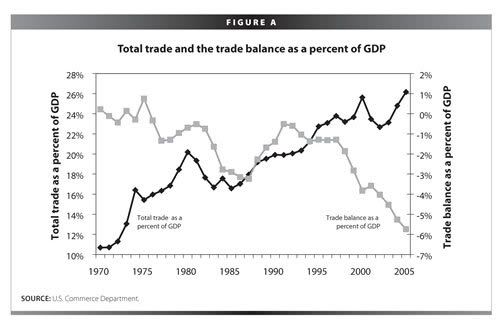
Faux’s briefing paper, “Globalization That Works for Working Americans,” was released Jan. 11 at the launch of a new network of progressive economists, the Agenda for Shared Prosperity. In it, he continues:
This dramatic shift reflects more than simply an increased movement of goods and services between the United States and other nations. It reflects an unprecedented economic integration with the rest of the world that is blurring the very definition of the “American” economy. American business is steadily moving finance, technology, production, and marketing beyond our borders. Some 50 percent of all U.S.-owned manufacturing production is now located in foreign countries, and 25 percent of the profits of U.S. multinational corporations are generated overseas—and the shares are rapidly growing.
As EPI economist Larry Mishel puts it, more trade, regardless of its terms, is not better for all of us. For many working Americans, the huge growth in foreign trade has resulted in the loss of family-supporting jobs, downward pressure on wages and increased inequality: From 2000 to 2005 alone, 3 million manufacturing jobs disappeared, at least one-third because of our trade deficit. But the greatest damage has been to wages— Mishel estimates as much as a loss of $2,000–$6,000 annually for the typical household. The doubling of trade as a share of our economy over the past 25 years has been accompanied by a massive trade deficit, directly displacing several million jobs. Mishel, who testified Tuesday before the House Committee on Ways and Means, told lawmakers:
That trade will make the distribution of income worse is embedded in fundamental economic logic. When American workers are thrown into competition with production originating from low-wage nations, both those workers employed directly in import-competing sectors and all workers economy-wide who have similar skills and credentials will have their wages squeezed. In fact, at the same time as trade flows with low-wage nations have increased, the distribution of income and wealth in the U.S. has grown more and more unequal.
Such a view is not confined to progressive think tanks.
Second article
posted by mrlewishistoricalsociety @ 9:11 PM
0 comments
Can we type it out or not? If so, how long does it have to be if we type it?
posted by Atilano @ 9:05 PM
0 comments
No Globalization, Please – We Are French!
posted by mrlewishistoricalsociety @ 8:58 PM
0 comments
R we suppose to bring the articles we find with our report or site them in the report?
posted by Carlos @ 8:25 PM
1 comments
Hey does anybody know how to get onto Ebsco? I looked all over the sheet that the library provided...nothing?
posted by Thumarut @ 8:24 PM
0 comments
I'm not exactly sure how to answer the first question about how the power struggle between TNCs and union changed? It's it based on our role's point of view, or just in any view? Thanks!
posted by Katie @ 7:25 PM
0 comments
Are we supposed to answer the 3 questions according to the article posted on the blog or are we supposed to fin our own articles?
posted by Maria B. @ 5:09 PM
2 comments
Local label finds favor on international fashion scene
 |
| Mavi Jeans are perceived in the U.S. as a high-quality brand. |
 AVI IS ONE OF Turkey’s few international brand names to have made its mark in a highly competitive environment where tastes are constantly changing – the fashion world. In particular, it has overtaken sales in Turkey of the all-American brand, Levi.
Mavi Jeans, produced in Turkey, have also gained a significant share of the U.S. market – particularly since the likes of Cher, Chelsea Clinton and MTV DJs have been spotted wearing them. Today, Mavi makes about 13 million pairs of jeans a year at its two factories in Turkey.
Its Cerkezkoy plant, about an hour’s drive from Istanbul, is the largest blue jeans factory in Turkey. Built on 25 acres of land, the factory has a covered area of more than 269,000 square feet and jeans are produced to international standards, using the latest American, German and Japanese technologies.
Mavi – the name means ‘blue’ in Turkish – now sells jeans throughout the world, from North Africa to Europe and from the Middle East to the Americas. Mavi will be opening its first international flagship stores in New York City and Vancouver this fall. It has showrooms in New York, Los Angeles, Dallas, Vancouver, Montreal, London, Frankfurt, Copenhagen, and most recently, Sydney. Worldwide sales exceed $200 million.
| The fit is the most important element and the starting point for Mavi |  |
| Ersin Akarlilar | |
The founder of Mavi Jeans, Sait Akarlilar, established his textiles business in 1971. In 1984 he turned to jeans production for big brand names such as Calvin Klein and founded the ERAK company. In 1991 he created his own brand, Mavi Jeans.
Ersin Akarlilar, the son of the founder and President of Mavi U.S., says: “In Turkey, everyone knows and takes pride in the fact that Mavi Jeans are Turkish. Since denim is universal, it has not consciously been a part of our overseas strategy to say that Mavi is a Turkish product.
“In the U.S. teen market, where your brand is from isn’t as important as quality and fit.
“A pair of jeans might be the latest fashion, but if the fit isn’t right, you won’t buy them. So fit is the most important element and the starting point for Mavi.”
| Turkey's Muslim Identity did not Prevent Turkey's Intense Relations with Europe by Abdullah Gul | ||
| Now that the European Commission has declared its favourable recommendation, | ||
Turkey has reached this point through a nation-wide effort, which reflects the underlying philosophy of the Republic and the democratic aspirations of the Turkish people and their determination to reach the highest contemporary political, economic and social standards. The overwhelming public support that Turkey's reform process enjoys within Turkey is telling in this respect. The growth of civil society has been especially instrumental in expediting Turkey's reform process. This strong consensus is also important for the adoption and implementation of volumes of EU legislation - acquis communautaire - required for Turkey's eventual membership. Having invested so much in this process of integration with the EU, the Turkish people merely expect to be treated fairly and equally as was foreseen for all candidates. As Turkey has advanced in its accession process to the EU in the past two years, the issue of Turkey's membership has received much international attention. The reasons are obvious: First, Turkey's geopolitical position has a direct bearing on the European Union's strategic vision and the international role it foresees for itself. Secondly, the comprehensive reform process taking place in Turkey, which has been followed closely by foreign audiences and experts, has a significance of its own. Turkey's performance regarding reforms has been impressive. The logical next step in Turkey-EU relations - opening of the accessions negotiations -will have positive reverberations in a wider geography. As the December deadline approaches, hesitations, second thoughts, but also misrepresentations and even prejudices on the part of some have resurfaced. We have taken these seriously and tried to make our case as clear as possible. It has to be said that Turkish membership presents a challenge to the EU due to Turkey's size. Turkey's relative economic weakness and large population are cited by some as disadvantages. Yet, the opposite argument has more clout. Economics and demography do not lend themselves to misrepresentation if properly analyzed. The potential of Turkey's vibrant economy, its entrepreneurial strength and the expected levels of growth are promising. The present positive trend in the economy and the economic reforms that complement the political reforms are positive signs. As for demographic trends, the Turkish population is expected to stabilize around 85 million by 2025, far from exceeding the 100 million as some would like the European public to believe. With the expected increase in foreign investments in Turkey following the start of accession negotiations, domestic demand for labor is likely to diminish the willingness of Turks migrating to Europe en masse in search of jobs. More importantly, given the worrying demographic trends in Europe (falling birth rates and even decreases in population in some cases) over the next few decades, the young population of Turkey can be viewed as an asset rather than a hypothetical liability for the EU, as mentioned by several independent reports and the impact assessment study conducted by the Commission. The European Union has a strategic objective to extend its security and stability through building "consensus", as opposed to relying on coercion. Turkish membership will be a proof of EU's capacity to generate harmony by extending the European space of peace on the basis of common goals and shared values. In this respect, Turkey's membership will give substance to the European idea that diversity is richness and that unity in diversity is desirable. I believe that, at a time when prophecies about a clash of civilizations can still make headlines, the European Union stands to gain much from Turkey's eventual membership. The Muslim identity of the Turkish population has not prevented it from interacting intensely with the West in general and Europe in particular, or from becoming an effective member of European institutions and organizations. Indeed, the successful conclusion of Turkey's accession process to the EU will represent the harmonization of a predominantly Moslem society with the peoples of Europe on the basis of common universal and democratic values. This will on the one hand facilitate the better integration of the millions of Muslims living in Europe within their host societies, and on the other hand, demonstrate to the Muslim world that Europe, by gathering around shared values, is serious about overcoming the prejudices that form time to time surface concerning Muslim societies. Turkey is working to establish a culture of reconciliation as the basic working ethic among countries in its region. This is evidenced by the positive trend that Turkey's relations with its neighbors reflect for the last decade and more so recently. As Turkey advances towards EU membership, the credibility and effectiveness of its voice calling for modernization and democratic reform in its region will increase. Turkey-EU relations have a contractual background going back 41 years. We have every reason to expect that, EU leaders will observe this contractual framework and act with foresight and political courage on 17 December. In fact, almost all EU leaders have expressed favourable views regarding the opening of negotiations. The visionary approach that European leaders are expected to deliver will have political, strategic, economic and cultural reverberations on Europe's perception of itself and on its relations with adjacent areas and beyond. | ||
Turkey at the Crossroads
 | |
| Faithfuls in a Turkish mosque: The ruling party took the risk of alienating its Islamic base by offering to deploy troops against fellow Sunni Muslims in Iraq. | |
EAST LANSING: The bombs that exploded in Turkey in November have not only shaken the oldest secular Muslim country, they have also raised grave questions about Turkey's future and its membership in the European Union. Moreover, current politics reveal a new paradox: an Islamic party seeking close ties with the European Union and supporting Turkish troop deployments in Iraq as opposed to the traditionally pro-American military and the secularist, Kemalist political party increasingly lukewarm on both issues.
To understand the Turkish paradox, and the context in which extremist Islamic elements have mounted the attacks, one has to look at recent dramatic shifts in Turkish politics brought about by the rise of an Islam-based but highly pragmatic Justice and Development Party (AKP) and the gradual decline of the military's influence. The AKP's record in office makes clear that it is firmly committed to rooting out religious extremism, bringing Turkey into the EU fold, and developing close relations with the United States. The AKP demonstrated its commitment to the latter objective when in March 2003 it tried to get the Turkish Parliament to allow US troop deployment through Turkey into northern Iraq. That attempt failed, partly because of the government's inexperience and partly because of strong popular sentiment against such deployment. However, the AKP more than made up for this fiasco when it pushed through a resolution in Parliament in October sanctioning Turkish troop deployment in Iraq to help keep order in the volatile Sunni triangle. This initiative was aborted when Washington had second thoughts in light of opposition from the Iraqi Governing Council.
| |
It is interesting to note, in the context of the AKP's pro-West stance, that the secular Turkish military establishment may have been responsible at one time for aiding and abetting the shadowy Islamist organization whose offshoots bombed Istanbul in November. The story is rather murky. Yet there seems to be a consensus amongst Turkish analysts that the “jihadi” elements that committed the heinous acts were connected to or descended from the Turkish Hezbollah (not linked to its Lebanese namesake). This group had been armed and trained by the Turkish “deep state” – the code word in Turkey for the security establishment – to fight the Kurdish insurgency during the 1980s and the 1990s.
The Hezbollah originated in southeastern Turkey, the poorest part of the country, in the 1980s and spread its tentacles to the major urban centers farther west where it fought running battles with leftist political factions. Southeastern Turkey is also the area where the Kurdish population is concentrated and where the Marxist Kurdish Workers Party (PKK) was waging its secessionist insurgency against the Turkish state during the same period. The strongly Islamist Hezbollah, presumably drawn largely from ethnic Turks, was ideologically and politically opposed to the PKK's Marxist and separatist agenda.
| |
During the 1980s and 1990s, Hezbollah adherents, armed and trained by the military, and acting as vigilantes and death squads, were responsible for killing as many as 500 PKK cadres and members of the Kurdish intelligentsia. However, with the winding down of the Kurdish insurgency and the capture of its leader Abdullah Ocalan in 1999, the PKK threat has all but evaporated in the predominantly Kurdish areas in southeastern Turkey. This has meant that armed Islamist cadres were left without a job to do and were subsequently targeted by security agencies. Consequently, they have reverted to their original extremist agenda and have turned against the establishment that had fostered them earlier. In this sense, the Turkish Hezbollah bear an uncanny resemblance to the CIA-created and supported mujahedin in Afghanistan who were left without a cause after the Soviet withdrawal in 1989. The former have come to haunt the Turkish secular establishment just as the latter came to haunt the American establishment.
Turkey's paradox does not end there. Many thought that once in power, the AKP would indulge in identity politics to please its staunchly religious support base. The result would be if not outright opposition to entry into the EU, at least a very lukewarm attitude toward it. If anything, the AKP's posture has turned out to be exactly the opposite. The AKP has enthusiastically advocated Turkey's entry into the EU. Party leader Recep Tayyip Erdogan visited major EU capitals immediately after the party's victory in the November 2002 elections in order to drum up support for Turkey's membership. On the other hand, it is the secular military that has become increasingly lukewarm toward EU membership.
| |
It is not difficult to understand what lies beneath this paradox. The prospect of membership in the EU, which insists on civilian control of the military, ensures that the Turkish military will be forced to fade from the political scene. Furthermore, implementing EU human rights criteria, a precondition for membership, would ensure that the security apparatus – the “deep state”– would be unable to coerce political elements it does not like. It is thus not surprising that the military – traditionally the most secular element in Turkish society and considered to be pro-EU – has become lukewarm toward EU membership, and increasingly “nationalist” (read anti-European) in its tone.
A final paradox that needs explanation is the AKP's attempt to appease the US in the context of the war against Iraq, which was and continues to be widely unpopular in Turkey. Not only did the staunchly secular, Kemalist Republican People's Party (CHP) vote against US troop deployment in March, the military leadership, usually vocal on matters of national security, maintained a studied silence. Similarly, in October it was the AKP government that pushed through the deployment of Turkish troops into Iraq with the CHP lukewarm about it, and the military maintaining, very uncharacteristically,that this decision be better left to the political leadership.
The AKP government risked alienating its Islamic base by deploying troops against fellow Sunni Muslims based on a rational cost-benefit analysis. It calculated that having the US on its side would lead to several gains. First, economic benefits would accrue, including IMF loans. Second, as a quid pro quo, the US would be willing to use its influence on EU members to accelerate the process of Turkish admission. Third, and above all, it would deter the Turkish military, which values its links with the Pentagon and depends on the US for weaponry and training, from creating a constitutional crisis as it had done in 1997 when it forced the Welfare Party – AKP's Islamic predecessor – from power.
These apparent paradoxes should not be viewed as signs of Turkey's political immaturity. They are evidence of the AKP's intelligent reading and deft handling of the political situation in the country. Thus they contribute not only to securing the party's position in the polity but also consolidating democracy in Turkey.
Mohammed Ayoob is University Distinguished Professor of International Relations, James Madison College, Michigan State University. He was Visiting Professor of International Relations at Bilkent University, Ankara, Turkey, during Fall 2003.
posted by mrlewishistoricalsociety @ 7:18 PM
0 comments
Middle East Needs Turkey's EU Membership | |||
Ayse HAKIM, JTW | |||
(Cairo, JTW) - Turkey’s EU membership will not only affect the Turkic World (Turkey, Northern Cyprus, Azerbaijan, Kazakhstan, Uzbekistan, Turkmenistan and Kyrgyzstan) but also the whole Muslim world. The Arap countries in particular strongly support to Turkey’s EU membership expecting the membership will make contribution to regional stability and integrity. Syria and Jordan for instance perceive Turkey as the representative of the region in Europe. Syrian Prime Minister Naji Otri once said that Turkey is representative of Arab and Muslim world: “We observed this decision (Turkey-EU Talks decision) with great happiness. We are not only happy about this decision but we also support it… Turkey is getting closer to the EU and it will make us stronger also. The EU process is not only good for Turkey, but also for the Arab world. We hope the full membership happens in 3-5 years. We believe Turkey will do so. Of course Turkey will prove the counter argument of the civilization clash scenario. Turkey’s entrance to the EU as a Muslim country will serve to tell the problems of Islam world to the West. We see Turkey as representative of the Arab and Islamic world in the EU, and this gives authorization to it”. Istanbul Bridge Europe and Asia continents Similarly the AFP news agency reported today that “Turkey in EU would help the Muslim World”. Fares Braizat, researcher at the the Centre of Strategic Studies of the University of Jordan, told the AFP that Turkey’s full membership to the EU will be an encouragement for the region: “Turkey’s negotiations with the European Union are a sign of encouragement… For the arabs it means that Turkey could play a significant role within the European Union regarding the EU policies towards the Arab and Muslim regions. Turkey is seen by Muslim countries as a role model that has successfully balanced tradition and modernization. The Arabs look up to Turkey as a model for bringing modernization and democracy… This could inspire arab countries that if you introduce democratic reforms, it would mean you have the advantage of being considered for a better partnership with the European Union.” Dr. Sedat Laciner, Director of Ankara based Turkish think-tank International Strategic Research Organization, similarly argue that a EU-member-Turkey would be a great chance for the region and for the EU. “From Palestine to Indonesia, almost all of the Muslim countries see Turkey as a role model. If Turkey enters the EU as equal and full member, it will give a clear message to the Muslim world. Turkey’s membership would prove that Al Qaeda-kind religinonist terrorism is wrong. It would prove that an equal relationship with the West is possible for the Muslims.” Dr. Laciner added. Laciner told the JTW that the main problem of the Muslim world is victimization and lack of hope regarding the future: “The Palestine Problem, occupation in Iraq, Chechnya Problem, Afghanistan, occupation of Karabakh by the Armenians etc. created a great hopelessness. The Muslims think that there is no way but terrorism and violence. The majority of Muslim people do not trust their own government in solving the political, economic and social problems. They need to see a miracle. And Turkey is the miracle they need to see.” Dr. Sedat LACINER; Director of ISRO Many Muslim leaders, including Algerain, Indonseian and Palestinian leaders, declared that they see Turkey as a model. Palestinian Prime Minister Mahmoud Abbas for instance said “We see Turkey as a model on the way to democracy”. Similarly Ibrahim Al-Marasli from Lebanese newspaper The Daily Star argues that ultimately, Turkey’s entry in the EU can help undo myths in the Arab World and Europe. Al-Marasli also says that Europe’s Islamophobia is baseless: “Europe's Islamophobia and its fear of Turkey's "Middle Eastern" religion is unfounded for it is the Europeans themselves who are practicing a Middle Eastern religion - Christianity. They tend to forget that Christianity, like Islam, also emerged in the Middle East and that Jesus was a Middle Easterner. If Christianity is essentially a Middle Eastern religion, then Turkey's entry in the EU will prove that is there is room in Europe for two Middle Eastern religions.” Alistair Lyon, journalist from Reuters, also wrote “Many Muslims, like some Europeans, view the EU as a "Christian club". Admitting Turkey, a predominantly Muslim nation of 72 million, would erode if not shatter this image.” Abdel Raouf el-Reedy, chairman of the Egyptian Council on Foreign Relations, told the Reuters that Turkey’s membership to the EU will be a great message to the Arab and Muslim world. "It would send a message to the Arab world that a Muslim country can also become a part of Europe," el-Reedy added. Not only the Muslim and Arab world, but also the non-Muslims of the Middle East strongly support Turkey's EU membership. Israel for instance sees Turkey's membership as a great contribution to the stability and development of the region. The Jewish lobby in the European capitals and the United States have defended Turkey's membership for the years. Tel Aviv also officially declared its support to Turkey. | |||
posted by mrlewishistoricalsociety @ 7:16 PM
0 comments
http://www.loe.org/shows/segments.htm?programID=06-P13-00029&segmentID=8
posted by mrlewishistoricalsociety @ 7:11 PM
0 comments
 Print
Print  Email article 1 2 3 Next
 When people think of globalization as an urban phenomenon, they usually think of New York, London, and Tokyo—the command and control centers of the global economy. Yet most urban dwellers live in smaller cities and metropolitan areas with populations of fewer than 2 million residents. These smaller cities account for the majority of the global urban population growth of around 65 million people per year.
Smaller cities illustrate the tensions brought about by changes in the global economy. Neoliberal globalization, the increasing reliance on markets to drive economic development, has resulted in a particular set of urban forms in poor countries—a minority of economically successful residents inhabiting increasingly privileged spaces—while the poor are ever more marginalized both economically and socially. At the same time, global trends toward democratization and increased political participation have exacerbated tensions in cities where the majority faces limited economic options. Most observers know that markets create winners and losers and understand the ways in which neoliberal globalization increases the gulf between the rich and the poor. But there is less understanding of how neoliberal globalization is cast into the brick and mortar of cities in the developing world. The metropolitan area of La Paz-El Alto, Bolivia, provides an exemplary case that illustrates how globalization shapes cities and how these particular urban forms, in turn, threaten the political sustainability of neoliberal globalization.
La Paz, the seat of the national government, sits in a bowl below El Alto—literally “the heights”—in a fragmented metropolis of 1.6 million people. The twin cities have been aptly described as an indigenous urban center overlooking a colonial city. They dramatically demonstrate how social relations react to the historic constructions of the built environment. With increasing frequency over the past six years, growing inequalities resulting from neoliberal policies and expanding spaces for contestation have strained La Paz-El Alto’s social fabric to the point of eruption.
Although impoverished citizens in low-income countries can claim few advantages, the geography of the twin cities has dealt the poor a powerful hand. With its majority indigenous population sitting above La Paz, El Alto spreads out across the altiplano, the inter-Andean plateau. El Alto controls all but one of the roads that connect La Paz with the rest of the country. In a tradition that began with an indigenous siege in 1781, lead by Tupak Katari and Bartolina Sisa, residents of El Alto have regularly closed off roads and marched down the steep hills to the center of La Paz in protest of economic and social policies. In 2003 and again in 2005, this geographical advantage facilitated demonstrations that drew from powerful collective memories and a deep sense of marginalization and injustice to forge a movement that forced two successive presidents to resign.
Like other parts of the global south, where urban population has increased over the past 50 years from about 300 million to about 2 billion people, La Paz-El Alto has grown exponentially. The entire metropolitan area had a population of 320,000 people in 1950—El Alto was then a neighborhood of only 11,000 and the site of an airport and factories that required more space than was available in the narrow La Paz valley. The city began to grow following the 1952 revolution that freed the majority indigenous rural population from bonded labor on large haciendas. But El Alto’s growth noticeably took off in the early 1980s due to droughts and then neoliberal economic policies imposed by the IMF and the World Bank. Peasants, who could not compete with the flood of imported agricultural goods when borders were opened, moved to the city. They were joined by thousands of miners who made their way to El Alto when President Victor Paz-Estenssoro closed the state mines that had formed the core of Bolivia’s economy since the Spanish conquest in 1986.
In 1988, with its population approaching half the size of La Paz, El Alto became a separate municipality, hoping its independence would improve its access to resources. Fifteen years later, El Alto roughly equaled La Paz in size and the young city continues to sprawl across the altiplano today. As in cities in other low income countries, 60 percent of El Alto’s population is under 25 and its workforce is mostly non-unionized, often maintaining direct ties to the countryside and holding a strong sense of indigenous identity.
These arrivals created a political culture in El Alto and La Paz’s marginal neighborhoods that combines aspects of trade unionism with traditional indigenous forms of land-based organization (ayllu) within a context of marked economic insecurity and social frustration. This instability is physical as well: demand for land near La Paz has led to the construction of adobe houses built on steep and unstable cliffs surrounding the city’s basin. Mudslides and flooding occur during the torrential downpours during the rainy season that runs from December to February. The marginalization of housing for the urban poor is common to other developing countries, with the 1999 mudslides in Caracas Venezuela that killed more than 30,000 people serving perhaps as the most tragic example.
In the last 20 years, La Paz has also expanded down the valley to the south, where, despite limited stable land, middle and upper-class subdivisions have blossomed. The southern zone is characterized by large, modern homes set behind fortified walls and surrounded by trees, open streets, paved roads, and pedestrian areas. Service workers from the surrounding hills and El Alto come down the hill first to build the houses of the rich and then to cook, clean, and repair them, allowing families to reproduce the lifestyle of global elites. The area houses most of the international diplomatic corps as well as exclusive American, German, and French schools, along with the services found in international and elite enclaves throughout the developing world.
These conditions in the southern zone of La Paz are in sharp contrast with neighborhoods in El Alto, which are characterized by congested streets, unpaved sidewalks, low rise buildings in varying degrees of completion, and inadequate drainage. Fifty-four percent of El Alto residents rely on outdoor plumbing for access to water. In general, the built environment of La Paz reflects years of public investment. El Alto’s limited physical infrastructure, on the other hand, proclaims a city that outgrew the municipal government’s limited resources and ability to provide basic public services.
Planners in both cities have not controlled land use and human settlement. The demand for land by impoverished migrants, desperate for a place to live, has created a pattern of urbanization that does not follow legally defined land-use norms. While informal land use is common throughout low income cities with an estimated one billion people living in slums worldwide, these marginal settlements take very different forms in the two Bolivian cities. In La Paz, migrants living on steep slopes suffer from the seasonal threat of mudslides. In El Alto, developers have created subdivisions without providing basic services and ignoring regulations that require public space for schools, churches, and parks. In some cases, plans are approved on payment of fees that go no further than the pockets of public employees. In other cases, developers sell de facto titles and new owners define their lots with adobe walls.
Since the adoption of neoliberal policies in 1985, intense migration and local factory closures have made the informal economy an increasingly important labor-sink in both cities. Between 1992 and 2001 the informal economy grew by 60 percent in La Paz, with many of the workers commuting from El Alto. But this figure is dwarfed by the 162 percent growth in informal jobs in El Alto. Overall, the informal sector accounts for about 70 percent of the total urban labor force, a common figure for low-income countries.
Considerable tension, born of discrimination and economic differences, exists between El Alto and La Paz. A common perception in La Paz is that El Alto is dangerous and its residents are delinquents. This tension is reflected in the different ideologies governing the cities. La Paz is dominated by the logic of the market, which privileges individual actors, while El Alto resonates with the historic memories of collectivism and reciprocity, particularly those practiced in rural communities under the ayllu system, which promotes the idea of a shared well-being. El Alto navigates between the tension of immediate response to crisis and long-term proposals for progressive change. It negotiates between an indigenous identity based on an idealized, hybridized history and social demands that incorporate a westernized modernity.
While the two cities are now roughly the same size, La Paz raises about five times more tax revenue per capita, even though most of the area’s industries sit in El Alto. Since the 1994 initiation of a widely adopted World Bank policy of administrative decentralization and municipal expansion, 20 percent of the national budget has gone to the country’s municipalities. For a handful of Bolivian cities, like La Paz, with an independent tax base and the ability to raise their own resources, the administrative reforms have provided an important additional source of revenue. For El Alto, the reforms have brought the majority of municipal revenues, as the city has been unable to develop significant local revenue streams, in large measure because firms pay taxes based on the location of their head offices.
The participatory discourse surrounding municipal decentralization has restructured planning in both municipalities. Demands from citizen groups have consistently outstripped the municipalities’ resources and ability to provide public services. This is unsurprising given the public per capita revenues, including funds from World Bank debt restructuring programs that target the poor, of less than US$90 for the relatively wealthy city of La Paz and US$44 for El Alto.
While public resources are limited, a culture of corruption dominates both cities, reducing the purchasing power of public funds. Spectacular cases in La Paz include one mayor authorizing the sale of national parkland on the outskirts of the city, while another transferred four checks for US$25 million each to a Bahamian bank “for safe keeping.” In La Paz and El Alto, more than 10 mayors have been removed from office, many on charges of corruption. A 2002 audit of municipal accounts in El Alto was unable to find receipts for almost 25 percent of total city spending.
As in other low-income cities, endemic corruption also reduces the citizens’ willingness to pay taxes and participate in city planning. Municipalities’ efforts to increase tax collections are often perceived as generating booty to be divided among political parties. This has led to tax revolts in both cities, such as those in February and September of 2003. Distrust in government also means that citizens have less desire to participate in planning. To attribute the problem of political capacity simply to corruption, however, negates the depth and complexity of economic and political life. The problems of corruption are complicated by the economic and labor precariousness that define daily life for most residents.
In El Alto, Juntas de Vecinos ("neighborhood organizations") offer an important alternative site of citizen representation. According to El Alto sociologist Pablo Mamani, the Juntas commonly serve as neighborhood micro-governments. As the new settlements shaped by neoliberalism in El Alto expanded and stabilized, the Juntas played two key roles: they pressed the municipal government to install basic urban services and developed clientelist relationships with political parties to gain access to those services. In 1989 there were 166 Juntas in El Alto; by 2006 there were almost 550.
The rise of these residential, rather than work-based, organizations could have facilitated an expanded leadership role for women, as the home and its management is a woman’s traditional sphere in Bolivia. While women frequently participate in the Juntas' programs and actions, the organizations' roots in mining or peasant union structures have ensured that male leadership predominates. The Juntas, however, have achieved more female representation than most popular organizations; in 2004 women held 10 of 29 leadership positions, although they were not in central roles.
The Juntas have also played a key role in the emergence of El Alto as a primary site for resistance to neoliberal policies. The convergence of two political identities, miners’ and indigenous peoples,’ was critical in building the trade union and neighborhood organizations that challenge the existing political order. More than once they pushed their leadership aside to stage overt rebellions, mobilizing hundreds of thousands of people. The past five years of protest in La Paz highlight how social tensions can affect the physical organization of cities as well as how residents contest that organization.
The global push by international institutions towards democratization usually ignores the reality that ethnic identity or class position often determines perceptions of democratic practice. In Bolivia, neoliberal economic policies exacerbate the differences, even as neoliberal political democratization facilitated the December 2005 election of Bolivia’s first indigenous president, Evo Morales, bringing a peculiarly Andean form of apartheid to an end. It remains to be seen whether his election will remain a symbolic gesture or is the first step in dismantling the neoliberal agenda and reshaping the urban environment. While a Bolivian president may be removed as easily as he is voted into office, the inequalities of globalization that are cast into the physical infrastructure of the neoliberal city may prove harder to change. How Morales confronts the challenge of creating a new kind of indigenous metropolis in the Americas, 500 years after Spanish Conquest, will determine whether he remains in office longer than his predecessors.
Other cities throughout the developing world face similar challenges given the combination of neoliberal globalization that reduces resources for public services, rapid urban growth, and an economic system that is structurally unable to incorporate a youthful population into the labor force. The resulting frustration arising from spatial and economic marginalization creates a fertile recruiting ground for political, religious fundamentalist, or criminal groups that may threaten the stability of the markets that neoliberal globalization seeks to build. 
posted by mrlewishistoricalsociety @ 7:04 PM
0 comments


